There’s a reason certain areas of Chennai command a premium year after year, even when the broader real estate market slows. It isn’t always about luxury amenities or branded developers. More often than not, it comes down to one factor that investors consistently underestimate until it’s too late to act on it — transit infrastructure.
Proximity to a metro station is not a lifestyle feature. It is a value retention mechanism, and the data from every major Indian metro city confirms this. Areas within a defined radius of metro stations depreciate less during downturns, appreciate faster during growth cycles, and maintain demand even when comparable neighbourhoods further from transit lines go quiet. If you’re evaluating residential plots as a long-term asset, this is the single most important location variable to understand.
Why Transit Proximity Shields Value
The core logic is simple: people pay a premium to reduce commute friction. As Chennai’s traffic density increases year on year, the ability to step out of your home and reach the city’s commercial and employment hubs via metro becomes an increasingly rare and valued feature.
Apartments along metro corridors have proven this for years. But plotted residential developments near metro stations offer something apartments cannot — land ownership, with the full appreciation potential that comes with it. A plot near a metro station doesn’t just hold its value because of current demand. It holds it because every year that passes, the metro becomes more integrated into how the city functions, and the land that sits close to it becomes more irreplaceable.
Madhavaram and the Metro Equation
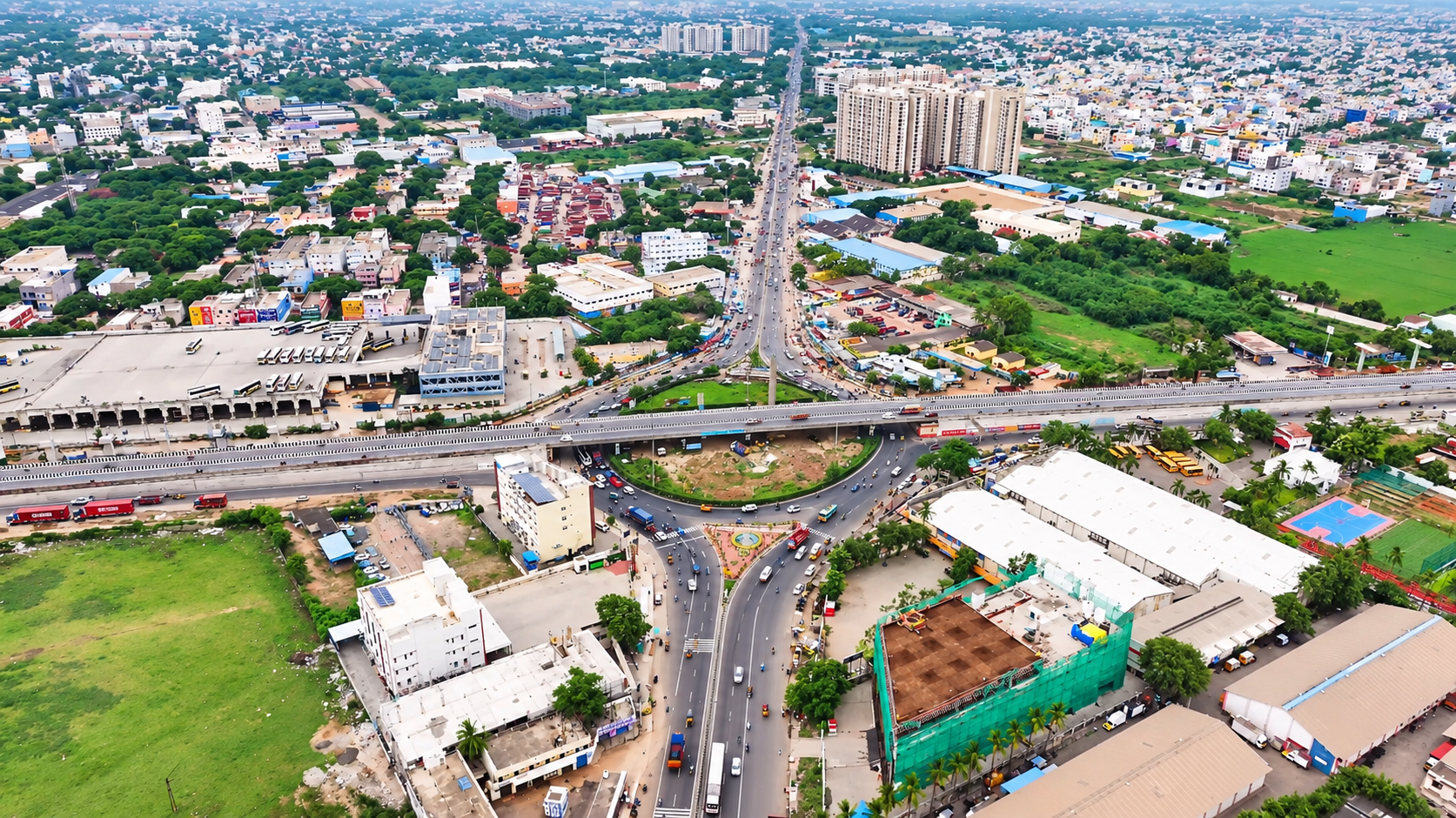
North Chennai’s transformation over the last several years has been driven by a combination of infrastructure investment, industrial expansion, and improved connectivity. Madhavaram sits at the centre of this shift.
The extension of Chennai Metro Phase 2 to Madhavaram is not a distant promise — it is a committed infrastructure project that is already reshaping how buyers and investors perceive this corridor. When a metro line confirms its route through a neighbourhood, land prices in that vicinity begin adjusting before the first train runs. The market doesn’t wait for the inauguration. It prices in the future.
Plots in Madhavaram benefit from this forward pricing mechanism, but because the area is still in the pre-operational phase relative to the metro’s full potential, entry valuations remain rational. This is the window that informed investors recognise and act on — not after the station is open, when prices have already reflected the upgrade, but while the appreciation curve is still in its early climb.
Why Plots Hold Value Better Than Apartments Near Transit
An apartment near a metro station is subject to supply pressure. Developers keep building. New towers come up. The supply of units in a transit-adjacent zone can increase substantially over a decade, which puts a ceiling on individual unit appreciation.
A plot has no such ceiling. The supply of plotted land in any given area is finite and shrinking. As the neighbourhood develops, fewer open plots remain available. The investors who acquired plots for sale in Madhavaram in the early phases of the area’s development are now sitting on assets whose scarcity premium grows with every new development that converts an open plot into a built structure.
This is why well-located residential plots near metro corridors have historically outperformed apartment investments on capital appreciation over a 7 to 10-year horizon.
The Madhavaram Advantage Beyond the Metro
Metro connectivity is the headline, but Madhavaram’s value proposition runs deeper. The area’s improving road network, its proximity to the Jawaharlal Nehru Salai and key arterial routes, the presence of established social infrastructure including schools, hospitals, and commercial establishments, and the broader industrial activity in North Chennai that generates consistent housing demand — all of these factors layer onto the metro story.
Buyers of plots in Madhavaram are not making a speculative bet on a single infrastructure project. They’re investing in an area that has multiple independent reasons to appreciate, with the metro acting as the most significant demand accelerator layered on top of an already-strengthening location.
The Closing Argument
Real estate value is built on scarcity and desirability. Metro proximity creates desirability. Plot ownership in a developing corridor creates scarcity. When the two converge — as they do in Madhavaram right now — the result is an asset that doesn’t just hold its value through market cycles. It builds on it.
The plots available today, before the metro becomes fully operational and before remaining inventory disappears, represent the most favourable entry point this corridor will offer. That window doesn’t stay open indefinitely.